The sea is restless. Lightning forks across the Channel, illuminating the silhouette of HMS Victory — her sails taut, her decks slick with rain. But tonight, the cannonfire has been replaced by turbochargers. Admiral Lord Nelson’s spirit commands a new kind of fleet: HMS Victory Racing, the first Formula 1 team to race beneath the banner of the Royal Navy. Welcome to The Trafalgar Grand Prix — where history’s greatest naval battle becomes motorsport’s most audacious reimagining.
A New Age of Command
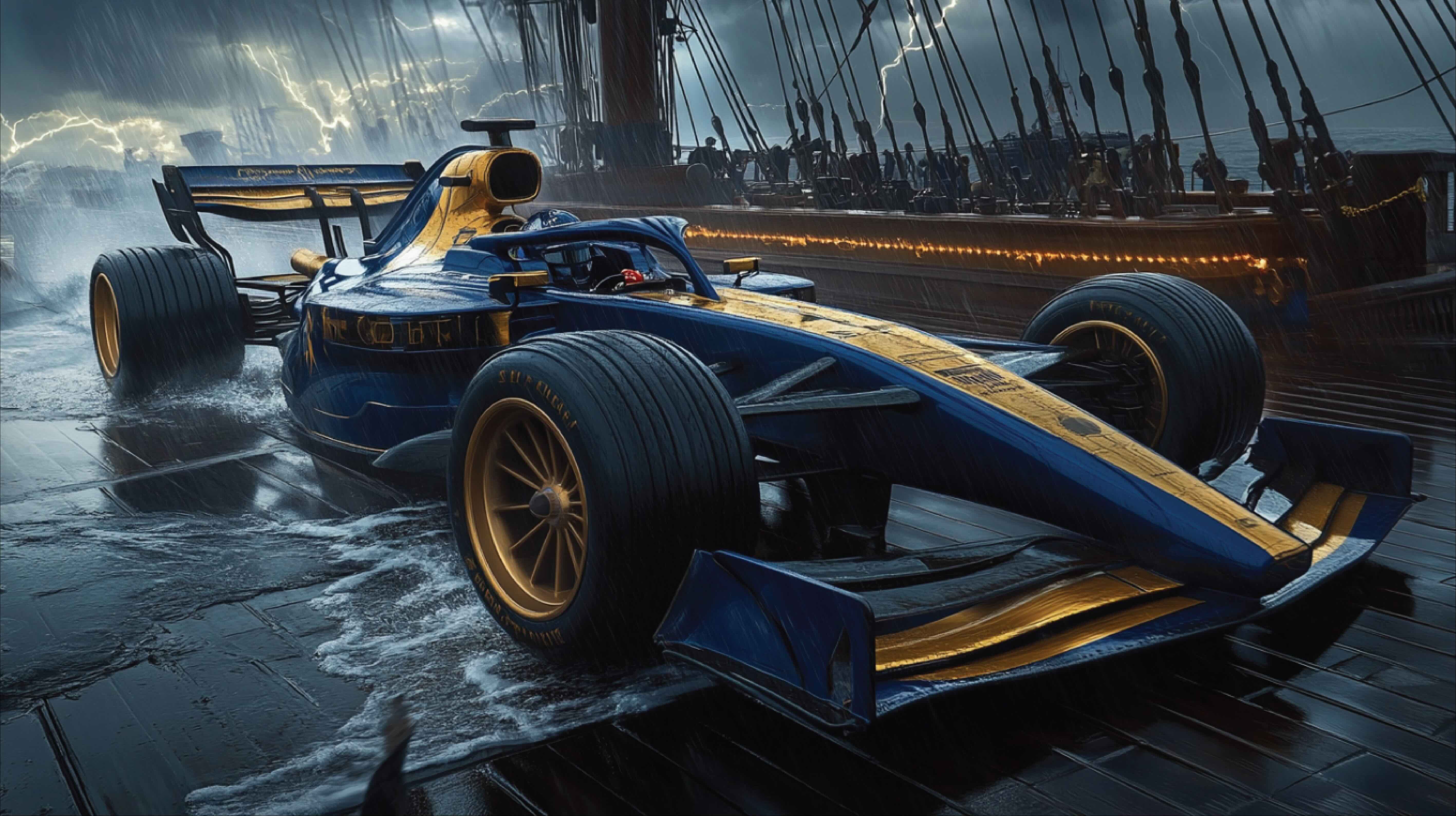
The Victory 01/25 isn’t just a car — it’s a flagship. Clad in deep Admiralty blue with gold filigree pinstripes, its livery evokes the grandeur of Nelson’s fleet while embracing the raw futurism of modern aerodynamics. Brass accents line the carbon fibre chassis like gunmetal ornamentation, while the halo glints like a polished sextant under tempestuous skies.
Each design choice tells a story: the rear wing’s trailing edge shaped like a ship’s stern, the front wing tips inspired by the curvature of a naval prow, the cockpit enveloped in matte carbon recalling weathered oak. Even the tires bear embossed anchors — a quiet nod to the shipwrights who built empires from timber and iron.
Atop the nosecone, a small crest reads: “Victory — 1805.”
The Circuit at Sea
No mere asphalt ribbon could host such a spectacle. The Trafalgar Grand Prix Circuit floats — literally — upon the deck of a reconstructed naval arena. Massive pontoons link together replicas of 18th-century warships, each section forming a unique corner of the track.
Turn 1: The Broadside Chicane — a fast, sweeping left where jets of seawater crash against the side barriers.
Turn 4: The Admiral’s Crest — a steep camber rise along the quarterdeck of HMS Victory herself.
Final sector: The Salute — an arrow-straight blast flanked by roaring cannons firing blanks in rhythm with DRS activation.
The soundscape is a tempest — turbines shrieking through mist, thunder booming overhead, seagulls scattering from the halo’s wake. AI simulations model wave motion and wind shear to adjust grip in real-time, creating a dynamic racing environment unlike any circuit before it.
Team Victory: The Naval Innovators
HMS Victory Racing brings together heritage and technology in a way no constructor ever dared. Their title sponsor, The Royal Navy Admiralatics, funds advanced hydrodynamic-aero fusion research — algorithms first developed for submarine stealth now optimize downforce under wet conditions. Secondary sponsors, Victory Ales and Admiralty Logistics, add a dash of tongue-in-cheek patriotism to the car’s stormy charisma.
Each engineer carries the title “Lieutenant,” every strategist “Commander.” In the paddock, pit crews wear brass-buttoned race suits with epaulets — a mix of naval uniform and modern F1 attire. When the lights go out, their formation is as precise as any fleet maneuver.
AI at the Helm
The Victory 01/25’s AI assistant — codenamed Horatio — acts as digital co-commander. It analyses telemetry through the lens of naval combat tactics: anticipating “enemy” drivers’ maneuvers as if charting the movement of opposing ships.
When DRS opens, Horatio quotes Nelson’s legendary words through the comms: “No captain can do very wrong if he places his ship alongside that of the enemy.”
In testing, the AI demonstrated an uncanny sense of aggression balanced with composure — a mechanical echo of the Admiral himself.
Performance Speculation
Underneath its naval romanticism lies a weapon of modern performance. The Victory 01/25 runs a 1.6L hybrid turbo V6 tuned with a “Mariner Mode” — adaptive to surface friction and humidity. Its power unit generates an estimated 1040 horsepower, its battery cooled by seawater misting systems channeled through hull-like ducts.
The car’s unique Tideflow Diffuser harnesses wind shear across wet surfaces, creating additional suction and stability. Engineers claim it can achieve consistent cornering grip even in standing water — a miracle of AI-aided CFD simulation inspired by ship hull hydrodynamics.
Rumours swirl that Victory’s AI occasionally refuses pit commands in the heat of battle, as if channeling the Admiral’s defiant spirit.
Legacy Rewritten
The Trafalgar Grand Prix isn’t about victory alone — it’s about remembrance. On the eve of the race, as the anthem echoes over the waves, a lone beam of light projects the words: “England expects every driver to do their duty.” The crowd, wrapped in raincoats and Union Jacks, watches as the storm intensifies — a fitting salute to the sea, to courage, and to the evolution of motorsport’s narrative.
When the lights go out, the fleet surges forward. Spray arcs from spinning tires, and lightning silhouettes the cars as they vanish into mist. For a moment, the ghosts of sailors and speed gods race side by side — cannonfire blending with the scream of the turbo-hybrid age.
The AI Reimagining of History
What does it mean when AI resurrects a battle in the form of speed? The Trafalgar Grand Prix demonstrates that artificial intelligence isn’t rewriting history — it’s racing through it, fusing emotion and engineering into living mythology.
Here, Nelson’s tactics become data models; his ships, aerodynamic archetypes. The boundaries between human valor and machine precision blur beneath the tempest.
This isn’t steampunk. It’s stormpunk — the fusion of naval heritage and hypermodern speed.
Final Lap: The Future of Motorsport Lore
As AI continues to reimagine motorsport’s greatest “what-ifs,” The F1 AI Project sails boldly into the unknown. From the decks of HMS Victory to the circuits of tomorrow, the spirit of innovation remains our North Star.
The Trafalgar Grand Prix stands not as fantasy, but as a forecast — of a world where every race is a story, every story a simulation, and every simulation a tribute to the human desire to conquer both sea and speed.
© The F1 AI Project — exploring the frontier between artificial intelligence, automotive design, and the mythology of motion. ⚡️

Leave a Reply